Traceability in Manufacturing: From Lot to Individual Part
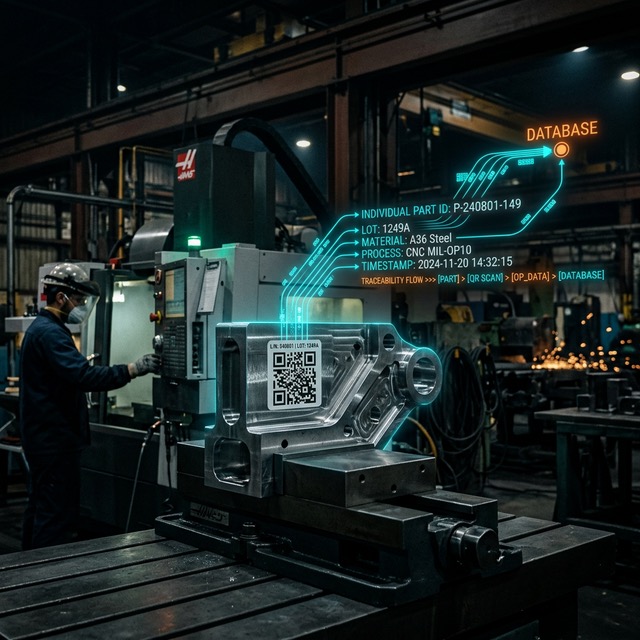
A complete guide to traceability in manufacturing. Learn the difference between lot-level and part-level traceability, how to implement it, and why it is key for quality and ISO.
Traceability in Manufacturing: From Lot to Individual Part
When a customer calls because a part failed, you need to answer three questions in minutes:
- Which raw material lot did it come from?
- Which machines processed it, and who operated them?
- Are there more parts with the same problem?
If your answer to any of these is "let me go look" — followed by hours going through production sheets, emails and spreadsheets — your traceability system isn't working.
And if you cannot answer at all, you don't have traceability. You have hope.
What Is Traceability in Manufacturing?
Traceability is the ability to track a product across its entire value chain — from the raw material it is made of, through every transformation, to its delivery as finished product.
Traceability works in three directions:
| Direction | The question it answers | Example |
|---|---|---|
| Backward (upstream) | Where does this part come from? | "This part used steel from supplier X, lot #2834" |
| Forward (downstream) | Where did this material go? | "Lot #2834 was used in orders 450, 451 and 453" |
| Internal (process) | What happened to it during production? | "Turned on CNC-3 by Juan, inspection OK, packed at 14:32" |
The three together give you complete traceability — what we call at Patok the product lineage.
Lot-Level vs Part-Level Traceability

Lot-Level Traceability
The most common and most basic method. An identifier is assigned to the production lot (a group of parts produced together), and that identifier is what gets tracked.
Example: you produce 500 metal brackets. You assign them lot LOT-2026-0342. If there is a claim, you look up that lot to find what raw material it used and which machines processed it.
Pros:
- Simple to implement
- Less data to handle
- Enough for basic regulations
Limits:
- Coarse granularity: if one part in the lot fails, you have to check — or recall — all 500
- You don't know the individual route: did every part go through the same machine? Or were they split between CNC-2 and CNC-3?
- Impossible to correlate part to operator: you can't tell whether the defective part was made by the morning shift or the night shift
Part-Level Traceability
Every part has its own unique identifier — a QR code, a serial, a tag — and its complete history is individual.
Example: every bracket has a unique QR code (WIP-2026-003421). You can see that this specific part:
- Was cut on saw #2 by Carlos at 09:14
- Turned on CNC-3 by María at 10:22 (cycle time: 4.2 min)
- Inspected — dimensions OK, surface OK
- Packed on pallet PAL-078 at 11:05
Pros:
- Total granularity: you know exactly what happened to each part
- Surgical recalls: if a part fails, you pull only the affected ones, not the whole lot
- Operator-machine-quality correlation: you can spot patterns ("parts from CNC-3 on the night shift have 3× more defects")
- Data for continuous improvement: every part generates cycle time, setup and stoppage data
The challenge: it needs a digital system that makes labeling and tracking every part practical, without drowning the operator in bureaucracy.
The 3 Levels of Traceability Maturity
| Level | Method | Granularity | Response time to a claim |
|---|---|---|---|
| Level 0 | Paper records, routing sheets | Lot (if the sheet was filled in) | Hours to days |
| Level 1 | Spreadsheet + lot labels | Lot | 30 min - 2 hours |
| Level 2 | Digital system with a QR per part | Individual part | < 5 minutes |
Most manufacturing SMBs sit at Level 0 or 1. Not for lack of interest — because traditional traceability systems (MES, ERP) were too expensive and complex to implement.
Anatomy of Part-Level Traceability
What information gets captured for each individual part? In a complete traceability system, each WIP (Work In Progress) carries:
Identity
- A unique ID (e.g. WIP-2026-003421)
- A QR code generated automatically
- The product it belongs to
- The production order it is tied to
Genealogy (Lineage)
- The raw materials it is made of (with the supplier's lot)
- The BOM (Bill of Materials) used
- Parent/child components in the case of assemblies
Process History
- Every operation performed (cutting, turning, welding, inspection…)
- The machine where it was processed
- The operator who ran it
- Timestamps for start and end
- Real cycle time vs standard
- Stoppages that happened during the process
Quality
- Inspection results
- Process parameters recorded (temperature, pressure, torque)
- Conformance or nonconformance
- Photos as evidence
Location
- The pallet or container it is in
- The current workstation
- The destination warehouse
How Do You Implement Part-Level Traceability Without Collapsing the Operation?
This is the manager's number one fear: "If I ask every operator to label and log every part, production will slow down."
And they are right — if you do it with paper, forms, or an MES with 15 mandatory fields. But with the right technology, logging takes 4-6 seconds per part:
The Flow With a QR Code and a Mobile Device
- Create — the part is created with a scan: a unique QR code is generated and a label printed (or a pre-printed sticker applied)
- Process — at each workstation, the operator scans the part's QR code and taps "Start". When finished, they tap "End". Two taps, 3 seconds
- Inspect — the inspector scans the part, logs the result (OK/NOK), attaches a photo if needed
- Move — when the part moves to a pallet or zone, one scan updates its location
With Patok Gemba, this flow is designed to be operated with gloves on, on a large screen, with no keyboard. The system generates each part's complete history automatically, without the operator ever having to think about "traceability".
Traceability and Standards: ISO 9001, ISO 13485, IATF 16949
ISO 9001 (General Quality)
Clause 8.5.2 of ISO 9001 states the organization must identify products by suitable means throughout product realization, and must identify the status of the product with respect to monitoring and measurement requirements.
In plain language: you need to be able to trace what happened to each product and prove it meets specification. Part-level traceability with QR codes satisfies this natively.
ISO 13485 (Medical Devices)
Requires mandatory traceability with unique device identification. There is no "by lot" option for implantable devices.
IATF 16949 (Automotive)
Requires complete traceability with efficient recall capability. If a defect affects a lot of parts shipped to an automotive OEM, you must be able to pinpoint exactly which parts are affected in minutes, not days.
For a detailed guide on preparing your plant for quality audits, read our article on how to prepare your plant for a digital ISO 9001 audit.
Traceability as a Competitive Advantage
Beyond regulatory compliance, part-level traceability creates three concrete competitive advantages:
1. Lower Cost of Poor Quality
When you can pinpoint exactly which parts a defect affects, your recall goes from "the whole 500-part lot" to "just the 12 parts that went through CNC-3 between 10:00 and 11:30 on Tuesday". That is 97% less recall cost.
2. Data-Driven Continuous Improvement
With part-level traceability you can correlate defects with machines, operators, shifts, materials and process conditions. Instead of "we have quality problems", you can say "80% of dimensional defects happen on CNC-3 when it runs steel from supplier B".
3. Customer Trust
When your customer asks about a part and 30 seconds later you send them its complete history — materials, processes, inspections, timestamps — the conversation changes. You go from supplier to trusted partner.
Identification Technologies: QR vs RFID vs Barcode
| Technology | Cost per part | Reading | Data it can hold | Best for |
|---|---|---|---|---|
| 1D barcode | ~$0.01 | Laser scanner | ~20 characters (ID only) | High volume, clean environment |
| QR code | ~$0.01-0.05 | Smartphone/tablet camera | ~3,000 characters (ID + metadata) | Discrete manufacturing, versatility |
| Passive RFID | $0.10-1.00 | RFID reader | 96-512 bits | Logistics, re-reading without line of sight |
| Active RFID | $5-50 | Automatic gateway | Kilobytes | High-value inventory, continuous tracking |
For most discrete manufacturing SMBs, QR is the optimal choice: practically zero cost, readable with any device that has a camera, and it stores enough information to uniquely identify every part.
A Real Case: From "I Don't Know" to an Answer in 30 Seconds
The situation: a metal parts contract manufacturer receives a quality claim — a batch of brackets has dimensional variation.
Without digital traceability:
- The manager gets the claim by email
- Searches the (paper) production records for the order number
- Tries to find the lot's routing sheet — can't, because it's in the shift-B supervisor's drawer
- After 2 hours, concludes it may have been CNC-2 or CNC-4
- Doesn't know which operator made it, or whether more parts are affected
- Decides to recall the whole lot (500 parts) as a precaution
With part-level traceability (Patok):
- The manager gets the claim with the serials of the affected parts
- Looks up each serial in the system — the complete history appears in 5 seconds
- Sees that every part was processed on CNC-2 by a specific operator, between 14:00 and 16:00 on Tuesday
- Confirms that only 18 parts of the original 500-part shipment went through that machine-operator-time combination
- Recalls only those 18 parts. The other 482 are confirmed good
- Identifies the root cause: CNC-2's tooling had been worn since 13:45
Time: 45 minutes vs days. Recall cost: 18 parts vs 500.
How to Start With Digital Traceability
Step 1: Define Your Minimum Level
Do you need lot-level or part-level traceability? If your industry is automotive, medical or tightly regulated: individual parts. If it's mass consumer goods with low risk: lot level may be enough.
Step 2: Choose Your Identification Method
For most SMB plants: QR codes printed on a thermal printer. Infrastructure cost: under $500 for the printer.
Step 3: Digitize the Logging
No more paper routing sheets. Every operation is logged with a QR scan. With Patok, the system automatically generates the complete history and each part's lineage.
Step 4: Connect It to Quality
Inspection records are automatically associated with the part. The inspector scans the part and logs the result. No more lost forms.
Conclusion
Traceability is not a regulatory luxury — it is an operational necessity. The question isn't whether you need it, but what granularity you require and how quickly you can implement it.
The good news: with QR codes and a digital platform like Patok, you can go from Level 0 (paper) to Level 2 (individual parts) in days, not months. And the first quality claim you resolve in 5 minutes instead of 5 hours will prove the value.
To go deeper on how a Digital Twin strengthens traceability, read our complete guide to Digital Twins in manufacturing.
Want to see how part-by-part traceability works in your plant? Book a free diagnostic Gemba Walk — we show you the complete lineage of your products in under an hour.
Topics
Related Articles
More on Traceability & Quality
Ready to transform your plant?
Book a free adoption session and find your biggest opportunity to improve with industrial AI.
Book an Adoption Session