Digital Poka-Yoke: Preventing Errors in Real Time
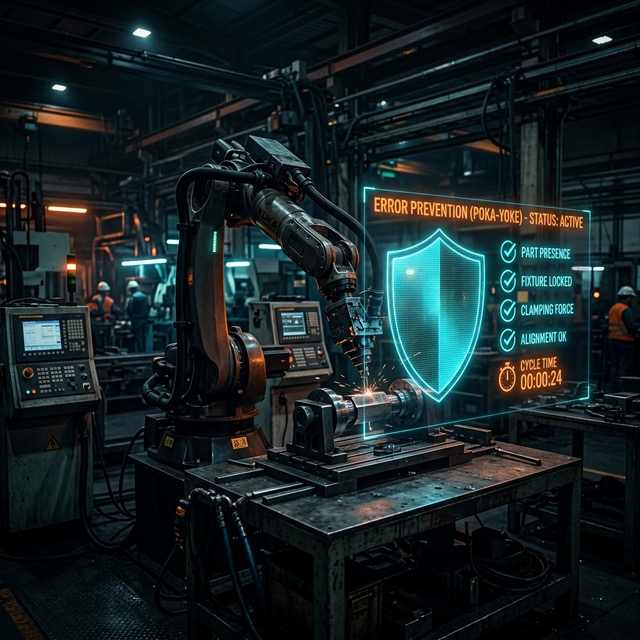
See how digital Poka-Yoke systems prevent production errors in real time. A practical guide for manufacturing with examples, types and tools.
Digital Poka-Yoke: Preventing Errors in Real Time
Poka-Yoke (ポカヨケ) literally means "mistake-proofing" in Japanese. It is a Toyota Production System concept designed by Shigeo Shingo around a radical premise: don't inspect to find defects — design the process so defects cannot happen.
A USB plug that only goes in one way is a Poka-Yoke. An ATM that returns your card before dispensing cash is a Poka-Yoke. And a digital system that won't let you process a part without a prior inspection is a digital Poka-Yoke.
Why Does Traditional Inspection Fail?
Classic quality inspection has a fundamental problem: it detects defects, it doesn't prevent them. By the time the inspector finds the bad part, you have already spent raw material, machine time, energy and labor producing it.
The Numbers
- A human inspector catches between 80-85% of visual defects. Which means 15-20% of defective parts move on to the next process — or to the customer
- In discrete manufacturing, the cost of poor quality (scrap + rework + claims) typically runs between 5% and 15% of sales
- Every defect the customer finds costs 10-100× more than catching it at the workstation where it happened (the Rule of 10)
The conclusion is clear: investing in prevention pays 10× better than investing in detection.
The 3 Levels of Poka-Yoke
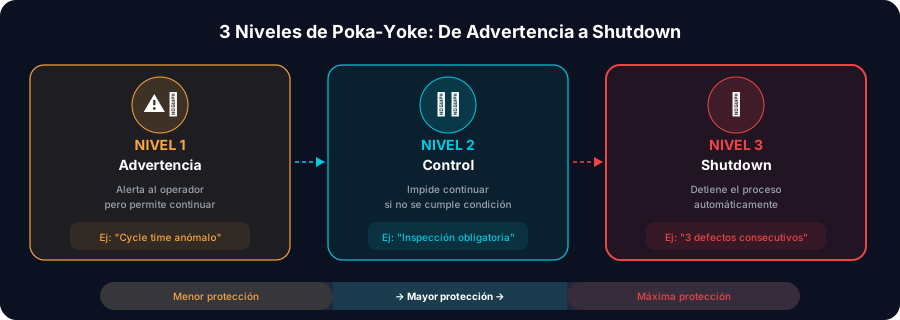
Shingo defined three levels of Poka-Yoke by how much they prevent:
Level 1: Warning
The system alerts when it detects an abnormal condition, but lets the operator continue.
Physical example: a traffic light blinking amber Digital example: an on-screen alert saying "this part's cycle time exceeded the standard by 40% — check quality"
Level 2: Control (Prevention)
The system blocks the operation from continuing when a condition isn't met.
Physical example: a mold that won't close unless the part is correctly positioned Digital example: the system won't move a part to the next workstation without an inspection result on record
Level 3: Shutdown
The system stops the process automatically when it detects an error.
Physical example: the Andon — Toyota's line stops when an operator pulls the cord Digital example: a Digital Twin that freezes the work queue when it detects 3 consecutive defective parts on the same machine
From Physical to Digital Poka-Yoke
Physical Poka-Yoke (Traditional)
Classic Poka-Yokes are physical mechanisms:
- Positioning fixtures: the part only fits the fixture one way
- Presence sensors: the machine won't start unless the sensor detects the part
- Mechanical counters: the machine stops when it reaches a part count
- Connector colors and shapes: a cable can only go into its correct port
They work, but they have limits:
- They need specific design and fabrication for each product
- They generate no data — they only block
- They don't adapt easily to product changes
- They are invisible to management (they work silently)
Digital Poka-Yoke
A digital Poka-Yoke uses software and data to prevent errors. It doesn't replace the physical kind — it complements it and extends it to scenarios physical mechanisms cannot cover.
10 Digital Poka-Yokes for Manufacturing
1. Process Sequence Validation
Error prevented: a part skipping an operation
The system knows the process routing (e.g. Cutting → Turning → Milling → Inspection → Packing). If an operator tries to log a part at Milling that hasn't been through Turning, the system blocks it.
With Patok Gemba, every part has a complete history and the system validates that it follows the defined sequence.
2. Mandatory Inspection by Stage
Error prevented: a part moving on without a quality inspection
The system requires an inspection record (OK/NOK) before releasing the part to the next stage. No inspection = blocked part.
This directly satisfies ISO 9001 clause 8.6 (release of products).
3. Raw Material Validation
Error prevented: using the wrong material
When starting an order, the operator scans the raw material. The system checks it matches the BOM specification. Scan 304 stainless when the order calls for 316, and the system raises an alert.
4. Abnormal Cycle Time Alert
Error prevented: a part processed too fast (incomplete process) or too slow (quality problem)
If the standard cycle time for an operation is 4 minutes and a part comes out in 1.5, something was probably skipped. The system flags the part for review.
5. Production Limit Without Inspection
Error prevented: producing 200 parts without checking quality
Set a rule: "inspect every N parts" (say every 20). On reaching the limit, the system blocks production until an inspection is logged. That implements digital statistical process control.
6. Machine Lock on Incomplete Setup
Error prevented: producing with the wrong setup parameters
Before producing, the operator has to confirm the setup parameters: tooling, CNC program, speed, material. If a mandatory field is missing, production cannot start.
7. Expired Material Lot Detection
Error prevented: using raw material past its date
For industries with shelf-life materials (adhesives, resins, compounds), the system checks the lot's expiry date at the moment of use.
8. Certified Operator Validation
Error prevented: an unqualified operator running a critical machine
The system checks that the operator logging into the machine holds the certification required for that process. No certification = the operation is blocked.
9. Defect Trend Alert
Error prevented: a gradual build-up of defects nobody notices
If a machine's defect rate rises from 2% to 5% over the last 2 hours, the system alerts the supervisor before it becomes a mass problem. It is a proactive digital Andon.
10. Incomplete Shipment Prevention
Error prevented: shipping an order with parts missing
Before closing a pallet for shipment, the system verifies that every part of the order is present and carries a "conforming" inspection status. If parts are missing or uninspected, the pallet cannot be closed.
Digital Poka-Yoke vs Traditional Inspection
| Dimension | Traditional inspection | Digital Poka-Yoke |
|---|---|---|
| Timing | After producing | During or before producing |
| Approach | Detect defects | Prevent defects |
| Cost | High (inspectors, time, rework) | Low (rules in software) |
| Coverage | Sampling (not every part) | 100% of parts |
| Data | Manual, late | Automatic, real time |
| Scaling | More parts = more inspectors | More parts = the same rules |
How to Implement Digital Poka-Yokes
Step 1: Identify Your Most Expensive Errors
Build a Pareto of your defects and nonconformances. Which 3 errors cost you most in scrap, rework or claims? Those are your candidates for digital Poka-Yoke.
Step 2: Classify the Type of Prevention
For each error, decide:
- Can it be prevented with data validation? (correct raw material, correct sequence)
- Can it be prevented with process alerts? (abnormal cycle time, defect trend)
- Can it be prevented by blocking the operation? (mandatory inspection, certified operator)
Step 3: Configure the Rules in Your Digital System
With a platform like Patok, Poka-Yoke rules are configured per product, machine or process. They need no programming — they are operational flow settings.
Step 4: Measure the Impact
Compare the defect rate before and after implementing each Poka-Yoke. The goal is a measurable reduction within the first 2-4 weeks.
Poka-Yoke and Digital Lean Manufacturing
Poka-Yoke is one of the pillars of Lean Manufacturing, but it was traditionally limited to physical mechanisms that are expensive to design and build. The digital version democratizes the methodology:
- A physical Poka-Yoke can cost $500-$5,000 in design and fabrication for one specific product
- A digital Poka-Yoke is a software setting that applies to any product, on any machine, and can be changed in minutes
The Patok Digital Twin acts as the visibility layer where every digital Poka-Yoke operates: sequence validations, process alerts, inspection blocks — all visible in real time to operators and supervisors.
Conclusion
The best quality system is not the one that catches the most defects — it is the one that prevents the most defects. Shingo understood that 60 years ago with physical Poka-Yokes. Digital technology takes the concept to the next level: prevention based on data, in real time, applicable to every part at every workstation, without investing in expensive physical mechanisms.
If your quality strategy today depends on inspectors checking parts at the end of the line, you are paying to find errors that could have been avoided. Digital Poka-Yokes change the equation: you invest in prevention, not detection.
Want to see how to implement digital Poka-Yokes in your plant? Book a free diagnostic Gemba Walk — we identify your 3 most expensive errors and show you how to prevent them with digital rules.
Topics
Related Articles
More on Traceability & Quality

Ready to transform your plant?
Book a free adoption session and find your biggest opportunity to improve with industrial AI.
Book an Adoption Session