Lead Time vs Cycle Time vs Takt Time: The 3 Time Metrics Every Engineer Must Master
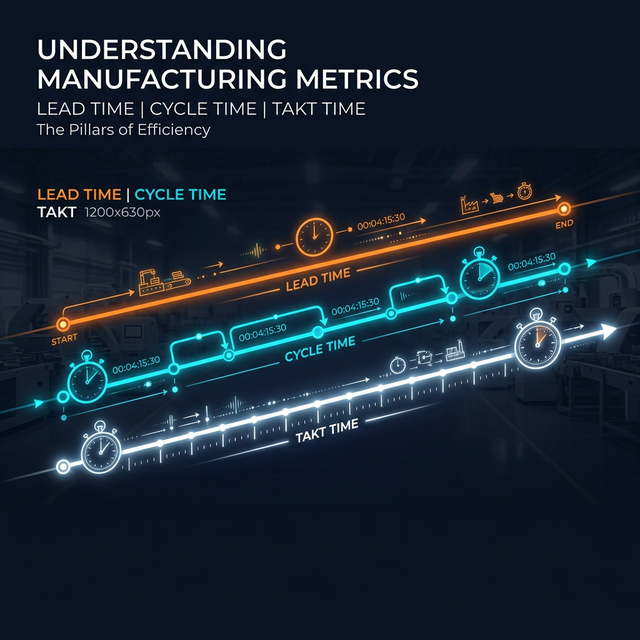
Understand the differences between lead time, cycle time and takt time. Learn how to measure each one and why confusing them can cost you thousands of dollars in production.
Lead Time vs Cycle Time vs Takt Time
If you are a production engineer, you have probably heard these three terms thousands of times — and probably watched colleagues use them interchangeably. They are not the same thing. Confusing them leads to wrong capacity decisions, broken delivery promises, and bottlenecks nobody understands.
Let's settle it once and for all.
Cycle Time: How Long One Part Takes
Cycle time is the actual time it takes a workstation or machine to complete one part, start to finish.
Formula
Cycle Time = Production time / Parts produced
Example: your CNC lathe ran for 6 hours (360 min) and produced 180 parts.
Cycle Time = 360 / 180 = 2 min/part
What You Need to Know
- It is a per-workstation metric. Every machine has its own cycle time.
- It varies by product. A complex part has a longer cycle time.
- It is the direct input for the Performance component of OEE.
- Micro-stoppages usually hide inside the average cycle time. If your theoretical cycle time is 1.5 min but the real one is 2.1 min, there are 0.6 min of hidden inefficiency in every part.
Lead Time: How Long End to End
Lead time is the total time from an order entering the system to the finished product being ready for the customer.
Formula
Lead Time = Delivery date - Order receipt date
Or in flow terms:
Lead Time = Processing time + Waiting time + Transport time + Inspection time
What You Need to Know
- It is an end-to-end metric that includes everything: queues, setups, processing, transport between workstations, quality inspection and waiting in the warehouse.
- The uncomfortable reality: in most plants, 95% of lead time is waiting, not processing. Your part spends 2 minutes on the lathe and 2 days waiting for the lathe to be free.
- Lead time is what the customer feels. They don't care about your cycle time — they care when their order arrives.
- Little's Law (WIP = Throughput × Lead Time) connects lead time directly to the amount of work in process.
Takt Time: The Pace the Customer Sets
Takt time is not a measured time — it is a calculated one, based on customer demand. It is the rate you need to produce at in order to meet demand without overproducing.
Formula
Takt Time = Available production time / Customer demand
Example: you have an 8-hour shift (480 min) minus 30 min of breaks = 450 min available. The customer needs 150 parts a day.
Takt Time = 450 / 150 = 3 min/part
Which means you need to turn out one part every 3 minutes to meet demand.
What You Need to Know
- If your cycle time > takt time, you will not meet demand. You need more capacity (another machine, another shift, or a shorter cycle time).
- If your cycle time << takt time, you are overproducing or you have idle capacity.
- Takt time changes when demand changes. It is not fixed — it is a target rate that gets recalculated periodically.
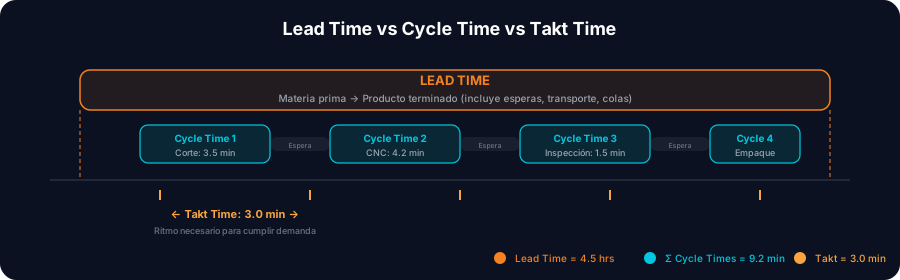
How the Three Metrics Relate
This is where many engineers get lost. The three are connected, but they measure different things:
| Metric | What it measures | Who defines it | Typical unit |
|---|---|---|---|
| Cycle time | The speed of one workstation | The machine/process | min/part |
| Lead time | The order's total time | The whole flow | hours or days |
| Takt time | The required pace | Customer demand | min/part |
The golden rule
For a healthy flow:
Cycle time ≤ takt time → you meet demand Minimum lead time → less WIP, less capital tied up, a happier customer
If the cycle time at a workstation exceeds takt time, that station is a bottleneck. The whole line is capped at its speed.
Common Mistakes
1. Saying "lead time" when you mean "cycle time"
We hear this constantly: "The milling machine's lead time is 4 minutes." No. That is cycle time. Lead time covers the whole journey, not one workstation.
2. Ignoring takt time
Many plants optimize cycle times without asking whether demand justifies it. Cutting your cycle time from 2 to 1.5 min is pointless if your takt time is 4 min — you are spending money improving something that already works.
3. Measuring cycle time with a stopwatch
Timing something three times by hand and averaging is not a real cycle time. To get a reliable figure you need statistical sampling (30 observations minimum) or, better, automatic measurement.
How to Measure These Metrics in Practice
The Manual Method
A stopwatch, a log sheet, and good luck with the operator remembering to write it down.
The Digital Method (Recommended)
A system like Patok automatically records the timestamps of every operation:
- Cycle time: computed automatically with every completed operation. Patok records the start timestamp (QR scan) and the end, giving real cycle times, not estimates.
- Lead time: the Digital Twin tracks each part (WIP) from creation to packing, computing the real end-to-end lead time including queues and waiting.
- Takt time: configured as a demand parameter, and the system compares it in real time against each workstation's cycle time, raising an alert when a station falls off the pace.
Conclusion
These three time metrics are the foundation of any continuous improvement system. If you don't measure them — or if you confuse them — you are making capacity, delivery and improvement decisions on quicksand.
Cycle time tells you how fast your machine is. Takt time tells you how fast it needs to be. And lead time tells you how much your customer suffers waiting.
Want to go deeper on how these metrics connect to overall efficiency? Read our Definitive OEE Guide, where cycle time is the star of the Performance calculation.
Ready to stop estimating and start measuring? See how Patok captures these metrics automatically.
Topics
Related Articles
More on OEE & Metrics


Ready to transform your plant?
Book a free adoption session and find your biggest opportunity to improve with industrial AI.
Book an Adoption Session