The shop floor
My floor runs on paper and WhatsApp groups
Solved byPatok Gemba
The shift's data, captured by your own people through a QR code.
Patok Gemba · Floor › Work
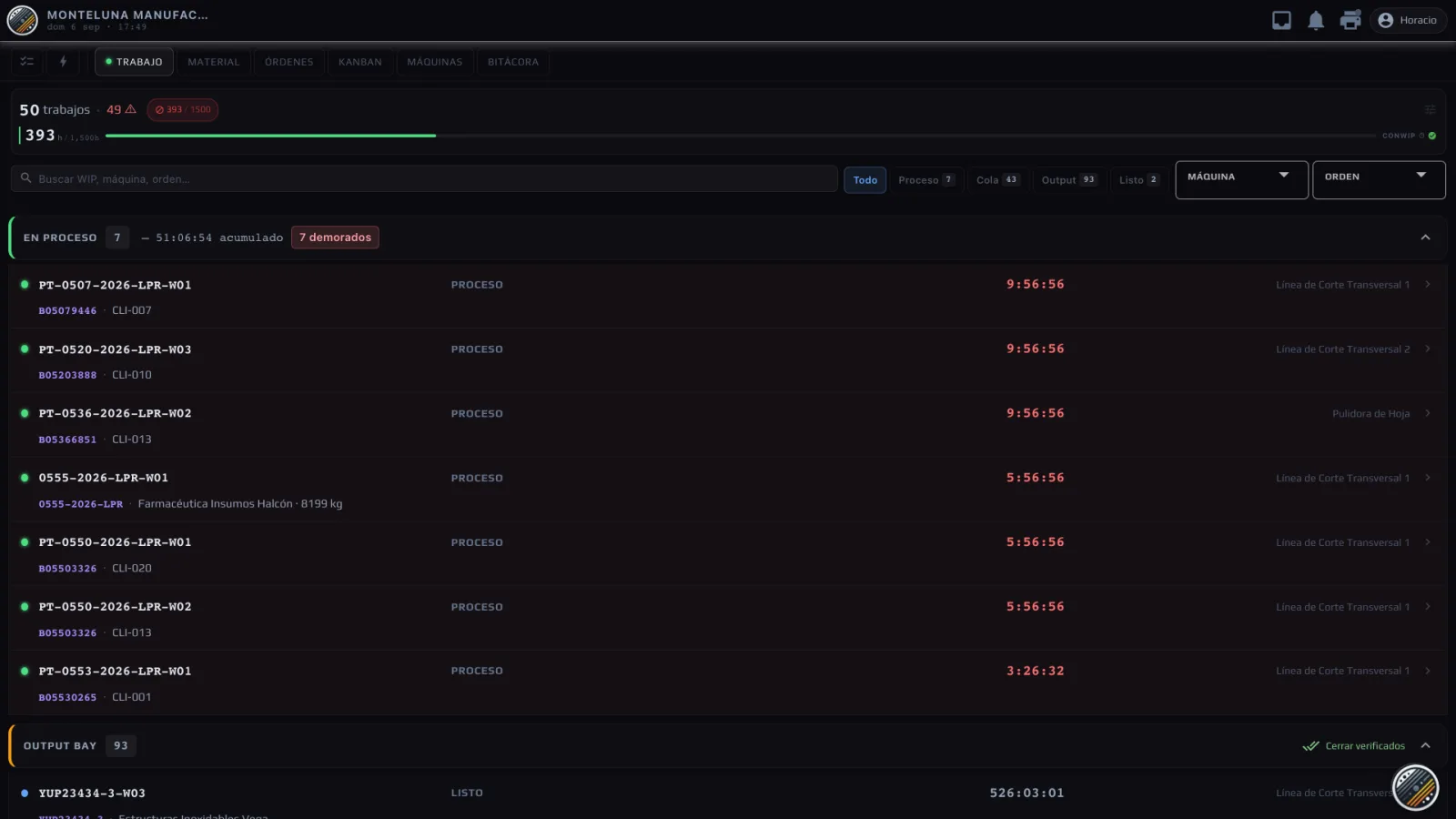
- A QR code on the machine
- No sensors, no PLC
- OEE, downtime and WIP, live
Your customer calls before your report does. Patok tells you which commitment is at risk, why, and what to move today.
Every plant absorbs its variability in three ways: time, capacity and inventory. Patok measures all three with your real data and prepares the decision for you.
Each door is a product with its own home and its own real screenshot. Find the sentence that sounds like your week and start there.
The shift's data, captured by your own people through a QR code.
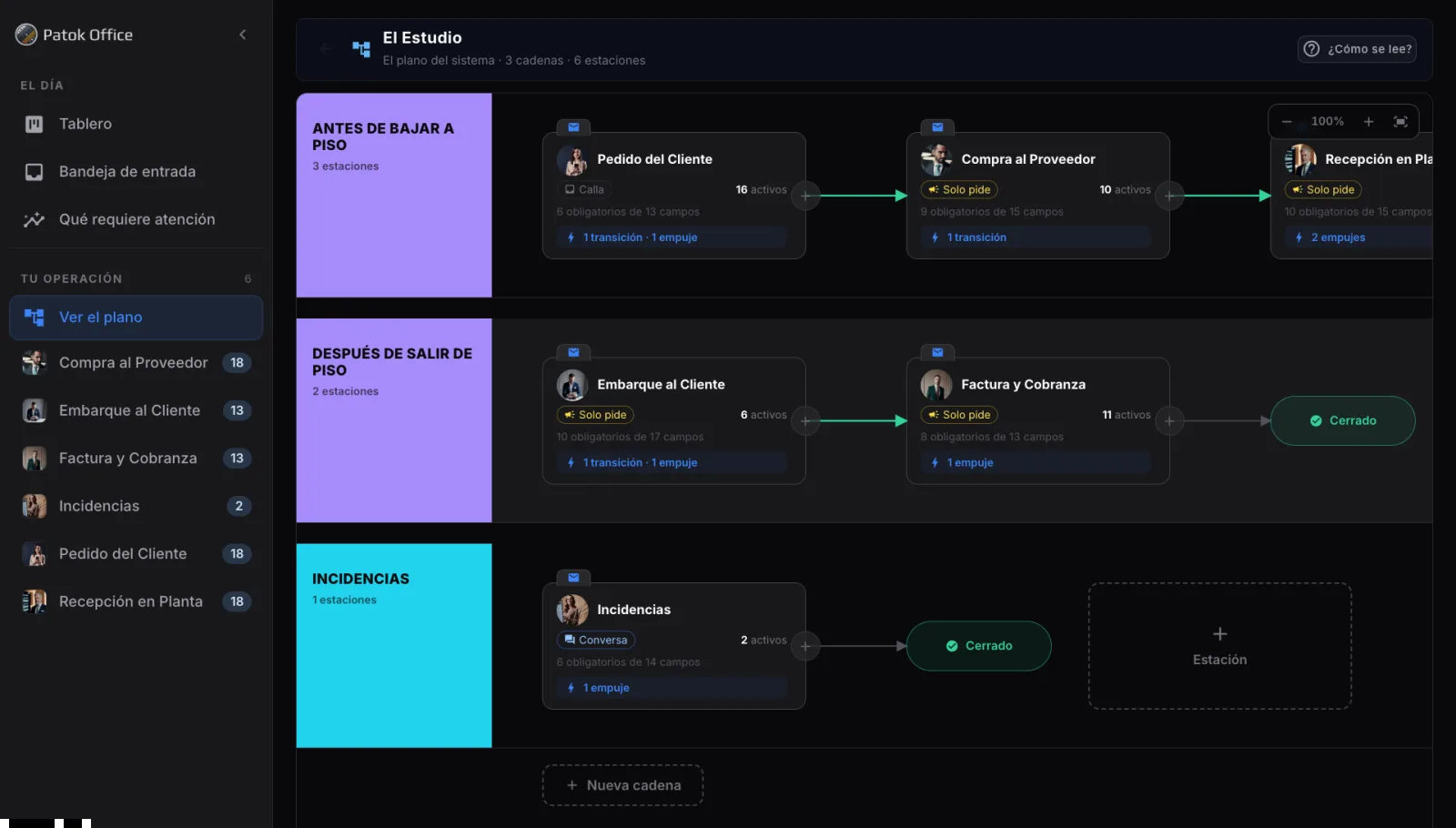
Office WIP, visible and measurable: three chains, six stations.
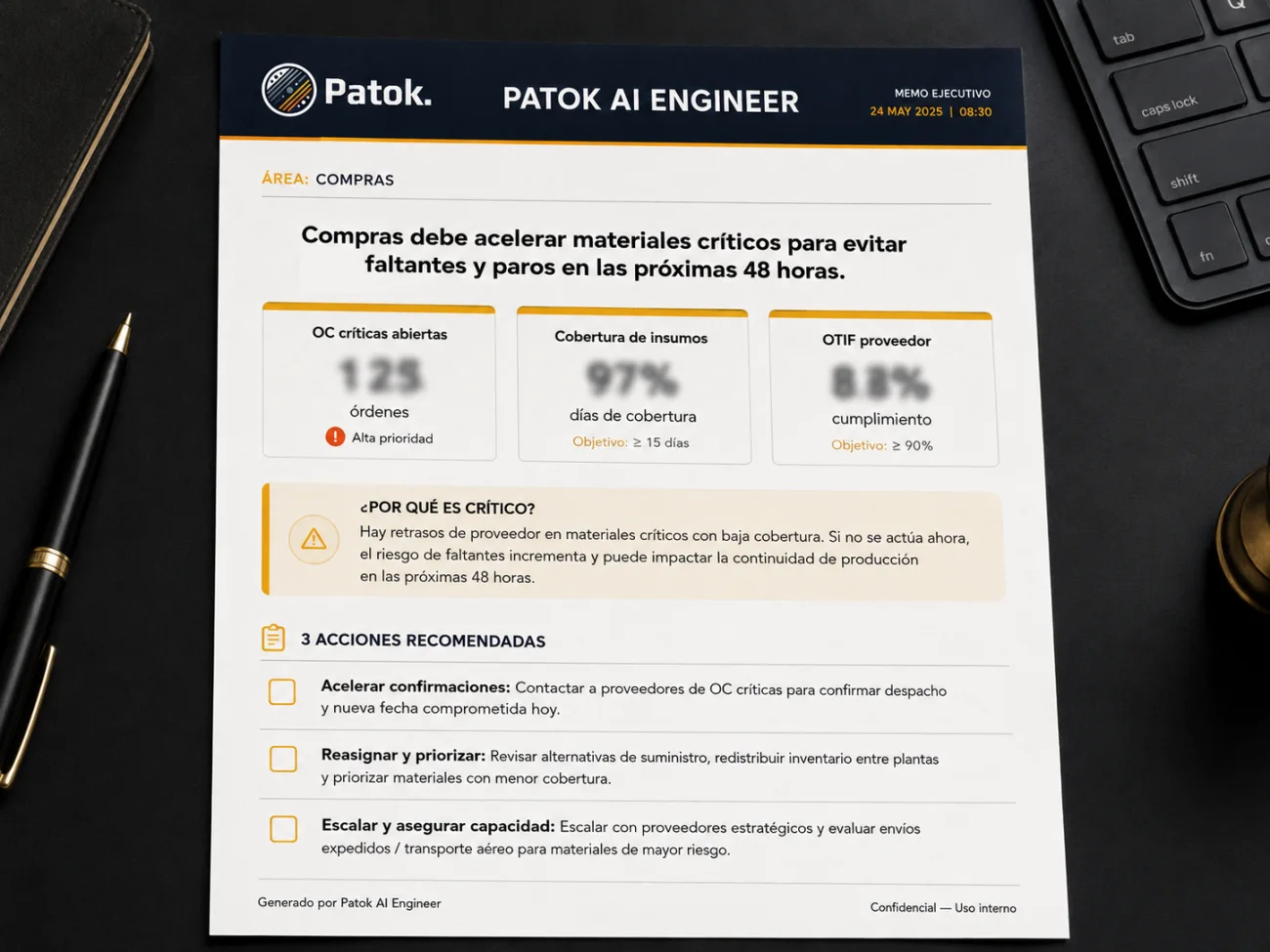
A memo in your inbox, every day, telling you what changed.
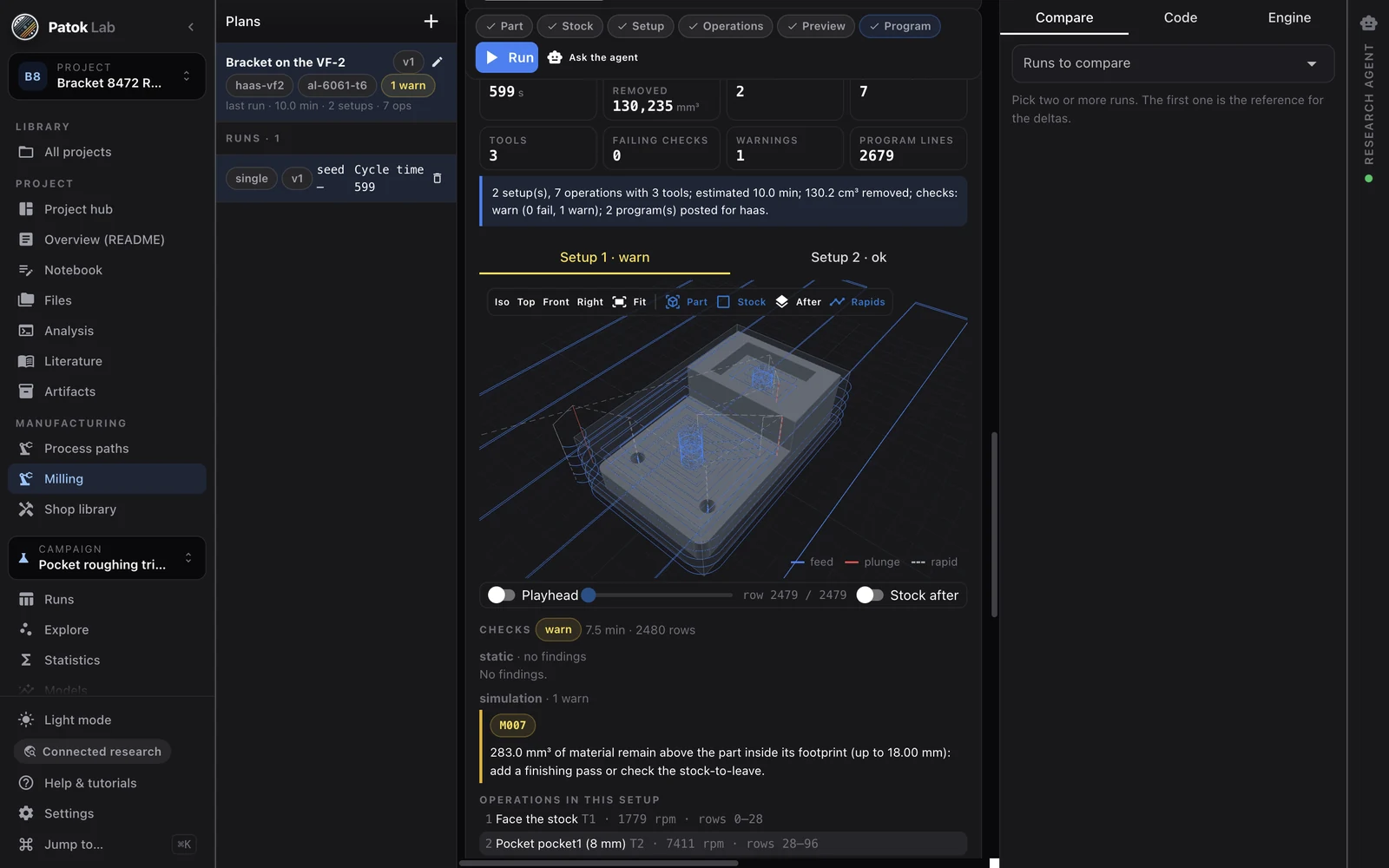
Your engineering work as artifacts: the part, the drawing, the manufacturing plan, the program and the next run — and nothing leaves your machine.
Would you rather see it all together? See the full platform →
These are not four products that happen to share a logo. All four do the same thing, in this order, and the order matters: skip a step and the next one has nothing to stand on.
The system does not decide for you. It leaves the decision ready, with what it takes to make it and to defend it later. Someone on your team makes the call, and the record shows who did.
The four doors are this same pattern applied in four different places: the shop floor, the office, the data your operation produces, and the lab. What changes is where you capture and what you analyze. The method does not change — which is why what you learn behind one door carries over to the other three.
Every late order comes down to the same thing: variability arrived and there was nothing to absorb it with.
Work orders, machines, materials, queues, people, surprises. Each one moves on its own and no board can show them all.
Time, capacity, or inventory. When variability hits, your plant pays with one of the three — even if nobody chose which.
There is no fourth. It is operations physics, not opinion.
A machine loses capacity, the queue grows, and a customer's date slips. Almost always without anyone noticing in time.
Resequencing spends time buffer to give the order back its margin. It is an explicit trade, measured with your real data.
Not a dashboard to interpret: the specific intervention that protects the delivery.
Representation of the flow model · not a simulation of your plant
The complexity of your plant is not managed event by event. It is managed by deciding how it absorbs variability.
What follows is one of the four doors told in full: Patok Cognitive, the analyst that reads your data and writes to you. The other three tell their own story on their own page.
A spreadsheet, an ERP, a data lake — or nothing yet. The starting point does not matter. What counts is that you leave with decisions.
The question that always comes up
— Does it integrate with our SAP?
— Your SAP already knows how to email a CSV. That is enough to start on Monday.
No API, no middleware, no IT project, and no vendor onboarding. Any ERP —SAP, Oracle, NetSuite, or one built in-house— knows how to schedule a report by email.
A spreadsheet, a PDF, or the report your ERP already emails. Through whichever channel puts you at ease.
Your operating criteria, your products, your customers. Not a generic model: your plant's.
Findings, risks, and actions. If it helps, we make it a routine — weekly or daily, you decide.
The trouble starts when the answer depends on something your plant never wrote down.
The question
"Why did the line stop on Tuesday?"
There is no possible answer. No AI can read data nobody captured.
The most it can do is tell you production dropped that week — which you already knew.
"Tool change. 1 h 18 min. Third time this month on that same machine."
And with that you can decide: it is not bad luck, it is a pattern.
That is where the platform begins — and only as far as it needs to go to hold up the decision.
And nobody does it. Not out of laziness — that is eighteen questions, and the shift starts at seven.
Today's operation · Aug 4 · 12 overdue, 4 due today
Patok reviews all of them, every day. And it only writes to you when something changed.
You do not need to know any of these formulas. They are needed so the number is right.
And after a few months, the thing that really matters happens: the plant stops depending on you remembering everything.
Not a demo with someone else's numbers. You send a file your operation already generates and we hand it back to you, read.
First analysis
with your data
Findings
Risks
Actions
+ And what data you are missing to hold up that decision month after month, not just once.
You pick the channel. We start with whatever puts you at ease:
The cost of waiting does not show up in any report. It shows up in the delivery date.
Send us a file from your operation. We will tell you which of those questions it can already answer.
We do this for manufacturing and industrial distribution companies that run their own operation. Scope is defined in a first 30-minute session — this is not open-ended consulting.
The thinking behind the product

Patok does not improvise: it applies the same criteria the engineering team behind Física de Planta teaches and uses in real operations. No Industry 4.0 hype.
Background and experience of the engineering team behind the method.
Lead time, WIP, buffers, and variability with proven theory, not rules of thumb.
Python and statistics on your real data — reproducible and auditable, not a black box.
Criteria and memos already used in real manufacturing plants, not in a lab.
Start from your files and emails; no sensors and no changes to your ERP.
The same doctrine that drives all four products, taught as a course. Start for free, get certified, and follow the track that fits you — with no platform to buy.
The course that explains why your plant stalls: WIP, throughput, lead time, queues and variability. No cost, no code required.
Every module you pass issues a micro-certificate you can share on LinkedIn, and finishing all 5 earns the Master Badge.
A free Open Track, Advanced Industrial AI modules, and Academy for Business to train your whole team.
The free course asks for no card and no commitment: an email address gets you in.
No. Patok lives alongside your ERP. The difference is that Patok focuses on the live operational flow: work orders, WIP, decisions, events, conversations, and actions. Your ERP stays your system of record; Patok is your system of intelligence.
Not necessarily. We can start with operational capture, QR, agents, documents, videos, or data you already have. How much instrumentation you need depends on the case. Many customers start with no extra hardware at all.
It is a complete adoption path. You can start with training (Flow Coach + Academy), move on to an assessment, and then implement the platform. The order depends on your maturity and your urgency.
That is what the assessment is for. We identify whether your biggest opportunity is on the shop floor (Gemba), in your data (Cognitive), or in the office (Office). The 30-minute adoption session is free and gives you clarity.
Yes. Patok Cognitive can turn scattered information — spreadsheets, PDFs, videos, emails — into a base you can query with AI, always with permissions, security, and scope defined up front.
It depends on scope. Flow Coach is live in minutes. An assessment takes 1–2 weeks. A pilot is scoped by processes, users, data, and the integration required. What matters is starting with the right case, not the biggest one.
You do not need to instrument anything to start. With what your operation already produces, we analyze one commitment at risk and tell you what to move.
Send us a file from your operation. We will prepare the first memo.