Digital Kanban for Manufacturing: Real-Time Flow Control
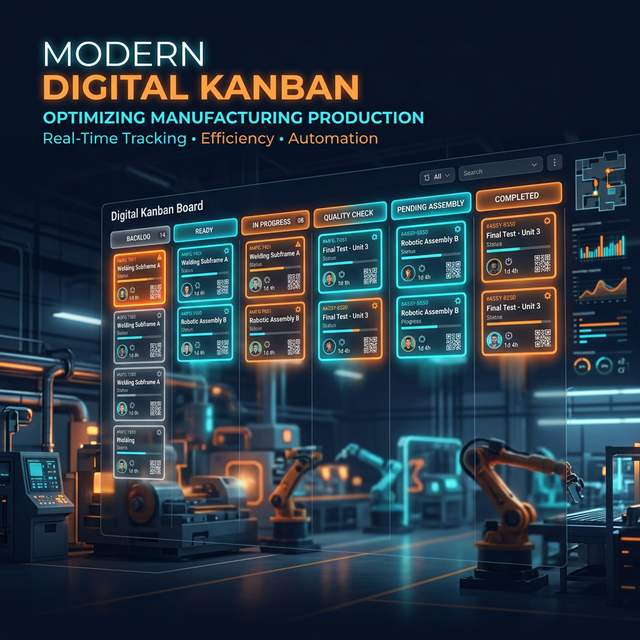
Find out how to implement digital Kanban in your manufacturing plant. Learn why the physical board doesn't scale and how digital Kanban connects to OEE and the Digital Twin.
Digital Kanban for Manufacturing: Real-Time Flow Control
Kanban was born on Toyota's lines as a system of physical cards for controlling material flow. More than 70 years later, many plants are still trying to run physical boards with Post-it® notes — and getting frustrated when it doesn't work.
The problem? Not the concept. The concept is brilliant. The problem is that physical Kanban doesn't scale to the reality of discrete manufacturing with high product variety.
The Principles of Kanban (Which Still Hold)
Before we talk digital, let's remember what makes Kanban so powerful:
- Visualize the work: every task, part or order is visible on a board with columns representing process stages.
- Limit WIP (Work in Progress): every column has a maximum. You cannot start something new until there is room. This prevents overload.
- Manage the flow: the goal is not to be "busy" — it is for work to flow continuously and predictably.
- Pull system: production is pulled by demand, not pushed by the schedule. You only make what is needed.
These principles are timeless. What changes is the medium.
Why Physical Kanban Fails in Manufacturing
1. Invisible From Anywhere Else
The board is on the floor. The manager is in the office. The director is in another city. Nobody sees the board unless they walk to it. That destroys the "visualize the work" purpose for the people making decisions.
2. It Doesn't Record Times
A physical card moves from column to column, but it doesn't record how long it spent in each stage. Without time data you cannot compute lead times, cannot detect bottlenecks, cannot improve.
3. High Variety = Chaos
If you run 50 different products with 200 active orders, your physical board becomes a wall of sticky notes nobody can read. In high-mix, low-volume manufacturing, physical Kanban collapses.
4. It Connects to Nothing
Your board is disconnected from inventory, from OEE, from the real capacity of the machines, from customer due dates. It is an island of information.
What Digital Kanban Adds
A digital Kanban solves every one of those limitations:
Total Visibility
Anyone with access can see the state of production in real time — from the floor, from the office, from home. The digital board is omnichannel: it shows on the plant kiosk, on the supervisor's tablet, in the director's browser.
Automatic Time Data
Every time an order moves column, the system records the timestamp. That automatically produces:
- Lead time per order (how long start to finish)
- Queue time per stage (where it got stuck)
- Real cycle time vs estimate (how well you plan)
Intelligent WIP Limits
Instead of a fixed limit per column, a digital Kanban can compute dynamic WIP limits based on real capacity (taking each workstation's current OEE into account). If your CNC is at 60% OEE today, the system automatically reduces how many orders can enter that stage.
Connected to the Ecosystem
Digital Kanban feeds on real data:
- Material inventory: you can't start an order if there is no material available.
- Machine capacity: the columns reflect real capacity, not theoretical.
- Due dates: orders are prioritized automatically by urgency.
- Real-time OEE: the flow adjusts to real capacity, not assumed capacity.
Digital Kanban + Digital Twin: The Winning Combination
The real power of digital Kanban appears when it is integrated with a plant Digital Twin.
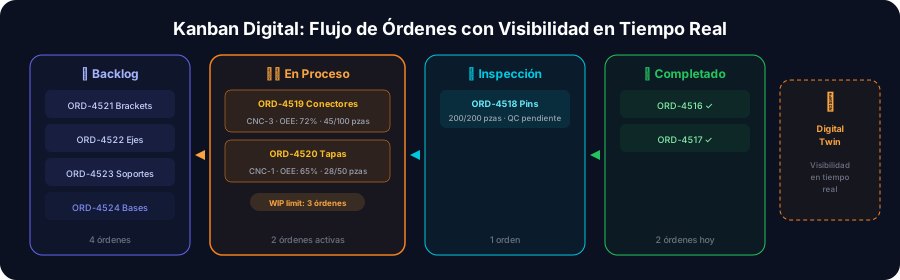
The Patok Digital Twin includes an integrated commercial Kanban showing production orders flowing through the real stages of the process. But unlike a generic board (Trello, Monday), this Kanban is connected to:
- The real machines: each column corresponds to a workstation with its current state (running, setup, stopped, maintenance).
- The physical WIP: each Kanban card corresponds to a WIP with a scannable QR code on the floor. It is not an abstraction — it is the real part.
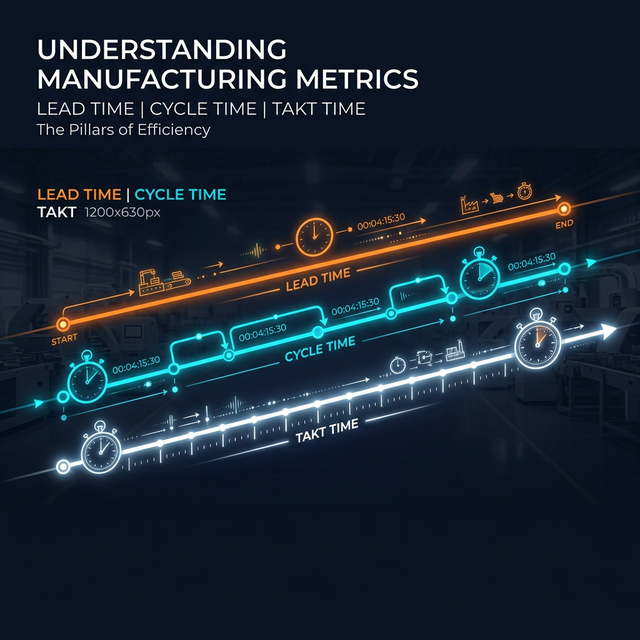
- The flow metrics: lead time, cycle time and takt time are computed automatically with every movement.
- The bottlenecks: the system detects where WIP accumulates and raises an alert when a workstation becomes the constraint.
That turns Kanban from a visualization tool into a control tool. You don't just see where the work is — you can act on problems before they turn into late deliveries.
How to Implement Digital Kanban in Your Plant
Step 1: Define Your Process Stages
Map the real flow of your production into columns. Don't copy the ERP's stages — go to the floor and watch where a part actually goes. Typically:
Raw material → Cutting → Process 1 → Process 2 → Inspection → Finished goods
Step 2: Set Initial WIP Limits
A simple rule to start: the WIP limit per column = 2× the number of machines or operators at that stage. Then adjust with data.
Step 3: Digitize the Order
Every production order becomes a digital card. With Patok, every part has a QR code the operator scans on receipt and on completion — the card moves by itself.
Step 4: Measure and Adjust
After two weeks, look at the data:
- Where does WIP accumulate? → the bottleneck
- What is the average lead time? → your improvement benchmark
- Are the WIP limits respected? → if they are always broken, either they are too low or you have a capacity problem
Conclusion
Kanban didn't die — it evolved. Toyota's principles are still the right ones: visualize, limit WIP, flow, pull. What changed is that today we can do it with real data, in real time, connected to the production floor.
If your plant still runs on sticky notes — or worse, doesn't use Kanban at all — the digital version is the fastest way to gain visibility and control over your production flow. And when you connect it to OEE and the Digital Twin, the result is a plant that practically runs itself.
Want to see digital Kanban wired into your production floor? Explore the Patok Digital Twin and see how to connect your production flow end to end.
Topics
Related Articles
More on OEE & Metrics


Ready to transform your plant?
Book a free adoption session and find your biggest opportunity to improve with industrial AI.
Book an Adoption Session