Digital Twin vs SCADA vs MES: Which One Does Your Plant Need?
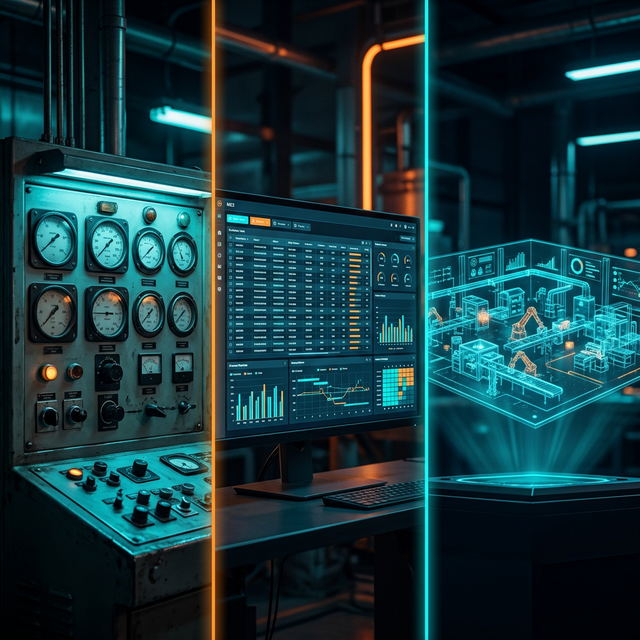
A practical comparison of Digital Twin, SCADA and MES for manufacturing. Understand what each one does, what it costs, and which is the best starting point for your plant.
Digital Twin vs SCADA vs MES: Which One Does Your Plant Need?
"We need an MES." "We should have SCADA." "Have you seen this Digital Twin thing?" You hear these three sentences constantly in manufacturing meetings, and they are almost always used as if they were synonyms. They are not.
Each one solves a different problem, costs a different amount, and demands a different level of maturity. Choosing wrong can cost you hundreds of thousands of dollars on a system you don't need — or worse, one nobody will use.
Let's separate them.
What Does Each One Do?
SCADA (Supervisory Control and Data Acquisition)
What it does: collects direct signals from machines (PLCs, sensors, actuators) and presents them on control screens. It lets you monitor and control process variables: temperature, pressure, speed, RPM.
Who it's for: automation engineers. The operator on an injection line who needs to adjust barrel temperature or watch mold clamping pressure.
What it does NOT do: it doesn't know which production order you are running. It doesn't know how many good parts you have made. It doesn't compute OEE. It doesn't manage production flows.
Typical investment: $50K-$500K+ (automation hardware, software licenses like Ignition, WonderWare or FactoryTalk, and PLC integration).
MES (Manufacturing Execution System)
What it does: manages the execution of production orders. It connects the plan (what you want to produce) to the floor (what actually gets produced). It handles order dispatch, sequencing, quality records, lot traceability.
Who it's for: production planning, supervisors, quality. The planner who needs to know whether order #4521 has started and how many parts are done.
What it does NOT do: it doesn't control machines directly. It has no real-time visual view of the floor. The interface is usually transactional — forms and tables — not visual.
Typical investment: $100K-$1M+ (licenses like Siemens Opcenter, Rockwell Plex, AVEVA MES, plus weeks or months of configuration, ERP integration and training).
Digital Twin
What it does: models the complete state of the plant in real time: every machine with its current state, every part in process with its location, every operational metric computed on the spot. It is the visibility layer that closes the gap between the floor and the office.
Who it's for: everyone. From the operator checking their work queue to the director reviewing efficiency from another city.
What it does NOT do: it doesn't control machines (that's SCADA). It doesn't replace the fine-grained order scheduling of an advanced MES. It is not an ERP.
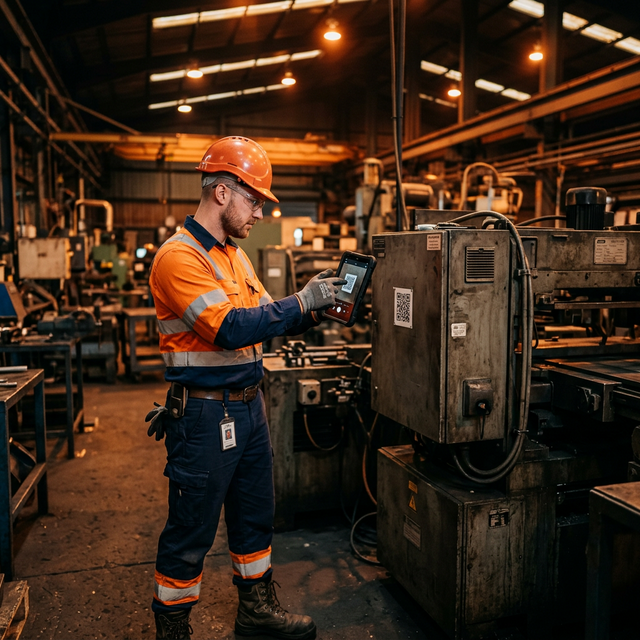
Typical investment: $5K-$50K (cloud platforms like Patok, tablets, QR codes. No automation hardware).
Detailed Comparison
| Dimension | SCADA | MES | Digital Twin |
|---|---|---|---|
| Main focus | Process control | Order execution | Operational visibility |
| Data it handles | Signals: temp, pressure, RPM | Transactions: orders, lots, inspections | States: machine running, queued WIP, OEE |
| Granularity | Milliseconds (signals) | Minutes to hours (transactions) | Seconds (events) |
| Interface | Process mimics, HMIs | Forms, tables, reports | Visual layout, state cards, dashboards |
| Hardware required | PLCs, sensors, gateways, OT networks | Servers, terminals | Tablets, smartphones, QR codes |
| Connectivity | OT network (Ethernet/IP, Profinet) | IT network (LAN, API to ERP) | Internet (cloud-first, WiFi) |
| Implementation | 3-12 months | 6-24 months | 1-4 weeks |
| Investment | $50K-$500K+ | $100K-$1M+ | $5K-$50K |
| Organizational change | Low (automation only) | High (processes, roles, ERP) | Low to medium (gradual adoption) |
| Computes OEE | ❌ (only supplies the base signals) | ⚠️ (can, but needs configuration) | ✅ Automatic |
| Multi-plant visibility | ❌ | ⚠️ (complex) | ✅ |
| Best fit | Plants with existing automation | Large plants with an ERP | SMBs and growing plants |
Complementary or Competing?
Complementary. All three sit at different layers of the industrial stack:
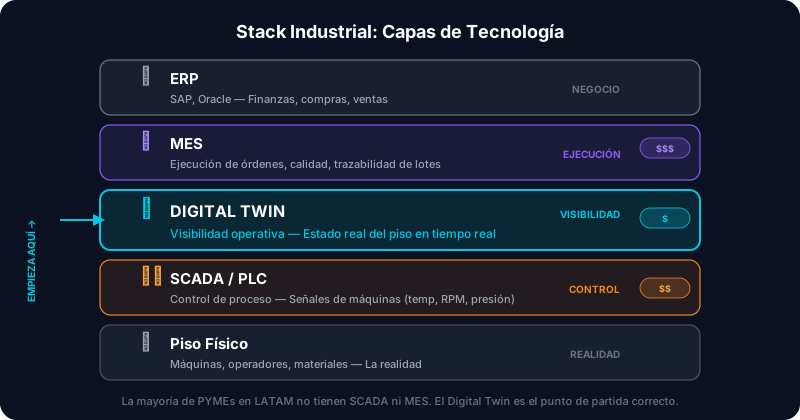
In a perfectly mature plant you would have all four layers. But the reality for most small and mid-size manufacturers in Latin America is:
- No SCADA (their machines aren't automated, or each one has its own isolated control)
- No MES (they use Excel, WhatsApp and the supervisor's memory)
- No ERP (or a basic one that never reaches the floor)
Where Should You Start?
If you have nothing: start with the Digital Twin. It is the lowest investment, the fastest implementation and the most immediate impact. You can have real operational visibility in weeks, not months.
If you already have SCADA: add a Digital Twin on top. SCADA gives you signals; the Digital Twin gives you operational context (which order you're running, how much WIP there is, what the OEE is).
If you already have an MES: check whether you really need it. 60% of MES implementations at SMBs fail from sheer complexity. A Digital Twin can give you 80% of the value at 10% of the cost.
The Most Expensive Mistake: Buying an MES When You Need Visibility
We have seen it dozens of times: a 30-person plant signs a $200K+ MES. The project runs 18 months. Operators hate the forms. Only 2 of 10 modules get real use. And in the end, the manager still calls the supervisor to ask "how are we doing?"
The problem was never that they needed an MES. The problem was that they needed visibility — and an MES is the most expensive, slowest way to get it.
A Digital Twin like Patok solves visibility first. If you later need advanced production scheduling, ISO quality management, or deep SAP integration, then an MES makes sense. But starting there is like buying a Ferrari to do the grocery run.
When You DO Need SCADA
- Continuous processes (chemicals, refining, water treatment)
- Critical process control where milliseconds matter
- Machines that need coordinated control (injection lines, industrial furnaces)
- Safety regulation that mandates monitoring specific variables
When You DO Need an MES
- Regulated manufacturing (pharma, medical devices) with FDA 21 CFR Part 11 records
- Very high volume with complex sequencing (automotive OEM, tier 1)
- Mandatory two-way integration with an ERP (SAP PP, Oracle Manufacturing)
- Lot traceability with regulated serialization
When a Digital Twin Is the Right Starting Point
- Small and mid-size discrete manufacturers (metalworking, plastics, assembly)
- Plants running today on Excel, paper or WhatsApp
- Limited budget but an urgent need for visibility
- Machines with no automation (standalone CNCs, lathes, mills)
- Managers who want to see their plant without walking the floor
If you recognize yourself in that last group, Patok Gemba was designed for you.
Conclusion
You don't have to choose between the three — you have to understand which one solves your problem right now. If your problem is process control, invest in SCADA. If it is executing regulated manufacturing, invest in an MES. If your problem is "I don't know what's happening in my plant", start with a Digital Twin.
Most plants in Latin America are in that last category. And the good news is that it's the fastest, cheapest and most effective one to solve.
For the full implementation guide, read our pillar article: Digital Twins in Manufacturing.
Want to work out what your plant needs? Book a free diagnostic Gemba Walk — in an hour we'll tell you whether you need SCADA, MES or a Digital Twin (spoiler: you most likely need visibility).
Topics
Related Articles
More on Digital Twin
Ready to transform your plant?
Book a free adoption session and find your biggest opportunity to improve with industrial AI.
Book an Adoption Session